Connecting learning to performance.
How I joined nine datasets from three enterprise systems, analysed 1.2 million records, and connected learning interventions to employee performance for the first time.
Date: 2023
Skills and technologies: Data Engineering · Statistical Analysis · Machine Learning (Regression Modelling) · Python: pandas, scikit-learn, matplotlib, seaborn
For years, my team evaluated training through engagement rates and user feedback. Both have value, but they can't tell you whether the training changed anything. I set out to find answers.
That meant accessing data my L&D team had never touched, building relationships across HR, operations, and data teams. Then engineering a dataset complex enough to track individual employees from their first week through to twelve months in role.
My organisation ran a structured induction programme for all new motor insurance retention consultants. These employees are critical to the business. Marginal improvements in their performance translate directly to revenue.
Despite this, we didn't understand how well the induction programme worked. The data was there, but it lived across three separate enterprise systems that L&D wasn't equipped to work with.
The hypothesis was simple: if we can benchmark new inductee performance against experienced staff, and track how that gap closes over time, we can make targeted decisions about training content, timing, and sequencing.
Data sourcing and access: I worked with the Motor Performance team to gain access to trading reports held on our AWS cloud data warehouse – data my team had never accessed before. I identified nine source files across three systems (our HRIS, LMS, and trading platform), totalling over 1.2 million records.
Analysis and modelling I conducted an exploratory analysis of KPIs – call volumes, retention rates, renewals, customer feedback, and quality assurance scores – across four employee populations: new inductees, existing staff, offshore contractors, and onshore contractors. I categorised employees into tenure bands, built linear regression models to predict retention rates, and investigated the relationship between cross-skill training and performance uplift.
The recommendation: New inductee performance was broadly comparable to experienced staff on most KPIs at around four to six months.
Call-to-save – the most commercially significant metric – takes longer, and the data suggests the turning point coincides with a cross-skill training programme typically delivered at six months.
So, does our training work? Yes – but we could do it better. My recommendation: pilot earlier delivery of cross-training. Measure the results against the benchmarks established here, and use A/B testing to validate the impact.
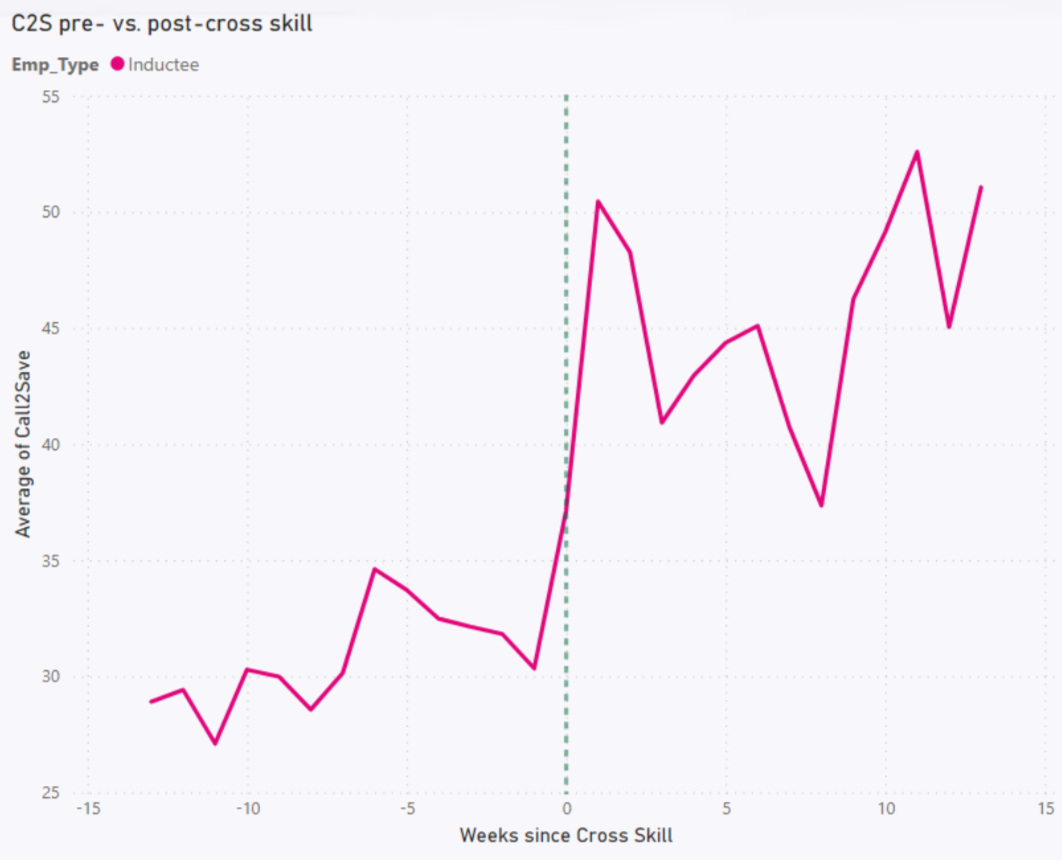
This project closed the loop between learning and performance. Now, business impact was shaping training decisions.
We could see that most new starter KPIs were comparable to experienced staff within four to six months – and the most commercially significant metric lagged behind for a specific, training-related reason.
The recommendation was concrete and testable: bring the cross-training forward, measure against the benchmarks, and A/B test the impact.
The recommendation was concrete and testable: bring the cross-training forward, measure against the benchmarks, and A/B test the impact.
Evaluation driving design.
"The insight we're seeing from your work is adding so much value to how we consider training moving forwards. You have an ability to draw out data comparisons I wouldn't have even thought of."